Did You Miss The Boat?

Timing
Uncertainty
Fear
Ever thought about owning that home in the mountains? Maybe a place at the beach? Or perhaps it isn't a second home at all. It's your first home, the larger home your growing family needs, or the place you've pictured yourself retiring someday.
You look. You dream a little. You might even find something that works.
But the timing doesn't feel quite right.
Maybe you're concerned about interest rates. Maybe you're waiting for prices to come down. Maybe there's uncertainty about your job, the economy, or simply what life will look like a few years from now.
So you wait.
There's nothing inherently wrong with waiting. Sometimes it's absolutely the right decision. But there's another side to that decision that doesn't receive nearly as much attention:
Waiting has risks, too.
Look back five years and the evidence is hard to ignore. In many markets, the home you considered buying then costs considerably more today. The payment you were waiting to make more affordable may not have become more affordable at all.
Does that mean you missed the boat?
Not necessarily. The ship hasn't sailed.
But it may be worth taking another look at what you're waiting for.
Affordability Has Changed
“Affordability” has become one of the most frequently used words in conversations about housing—and for good reason.
Home prices are substantially higher than they were five years ago. Mortgage rates are substantially higher than the extraordinarily low rates we became accustomed to during the pandemic years. Insurance, taxes and other costs have risen as well.
Even the mortgage industry's loan limits illustrate how dramatically the numbers have changed.
In 2021, the baseline conforming loan limit for a one-unit property was $548,250. In 2026, it is $832,750.
The nationwide FHA floor—important because FHA financing is commonly used by first-time and lower-down-payment buyers—rose from $356,362 in 2021 to $541,287 in 2026.
Loan limits don't cause home prices to rise, of course. But their increase is another reflection of just how much the housing landscape has changed.
And it raises an important question:
What does waiting actually cost?
Waiting for the “Right” Rate
Over the past several years, I've talked with plenty of people waiting for mortgage rates to come down.
I understand it.
Nobody wants to buy at 6.5% if they believe 5.75% is right around the corner. Nobody wants to refinance today if they think an even better opportunity might appear six months from now.
The problem is that markets don't send invitations.
Rates move quickly. Home prices move independently of rates. Personal circumstances change. And sometimes the opportunity we were waiting for appears—but we don't recognize it until it's gone.
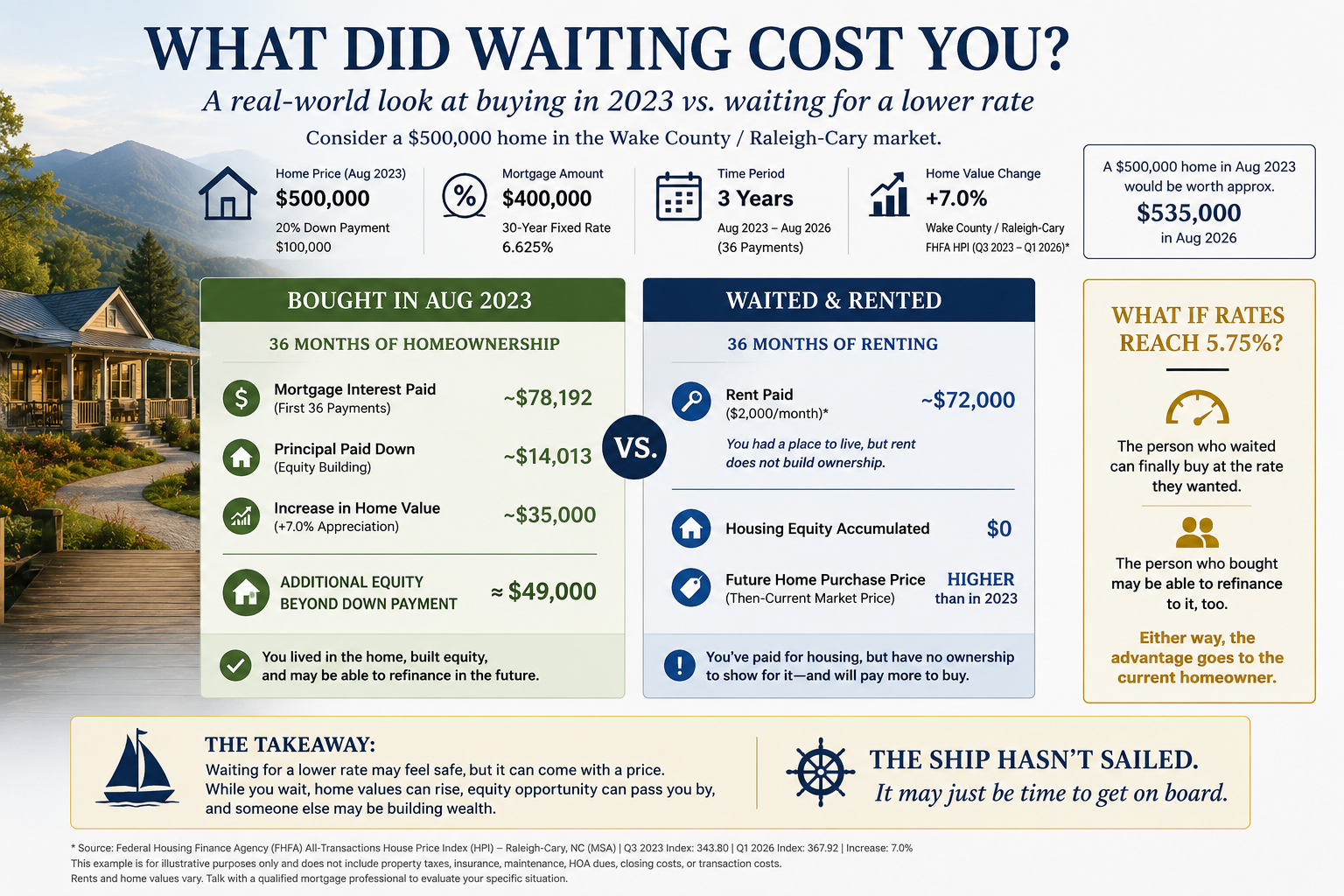
Consider a hypothetical buyer who could have purchased a $500,000 home three years ago at 6.625%.
Now imagine that buyer deciding instead to wait until rates reach 5.75%.
What happens if that rate doesn't arrive until 2027?
The buyer may indeed get the lower mortgage rate. That's a real benefit. But the rate isn't the only number that matters.
During those years, the person who purchased has been paying down principal. The home may have appreciated. And while a portion of every mortgage payment went toward interest, that buyer has also had three years of homeownership and equity accumulation.
Meanwhile, the person waiting still has to purchase the home at whatever price the market commands when the desired rate finally arrives.
That's the part of “waiting for rates” that is easy to overlook.
And there's another possibility.
If rates eventually fall meaningfully, the person who already owns the home may have an opportunity to refinance into that lower rate.
You can potentially change your interest rate later.
You can't go back and buy the house at yesterday's price.
What Happens When Everyone Sees the Same Boat?
There's another factor that doesn't show up on a mortgage calculator: competition.
Make it stand out
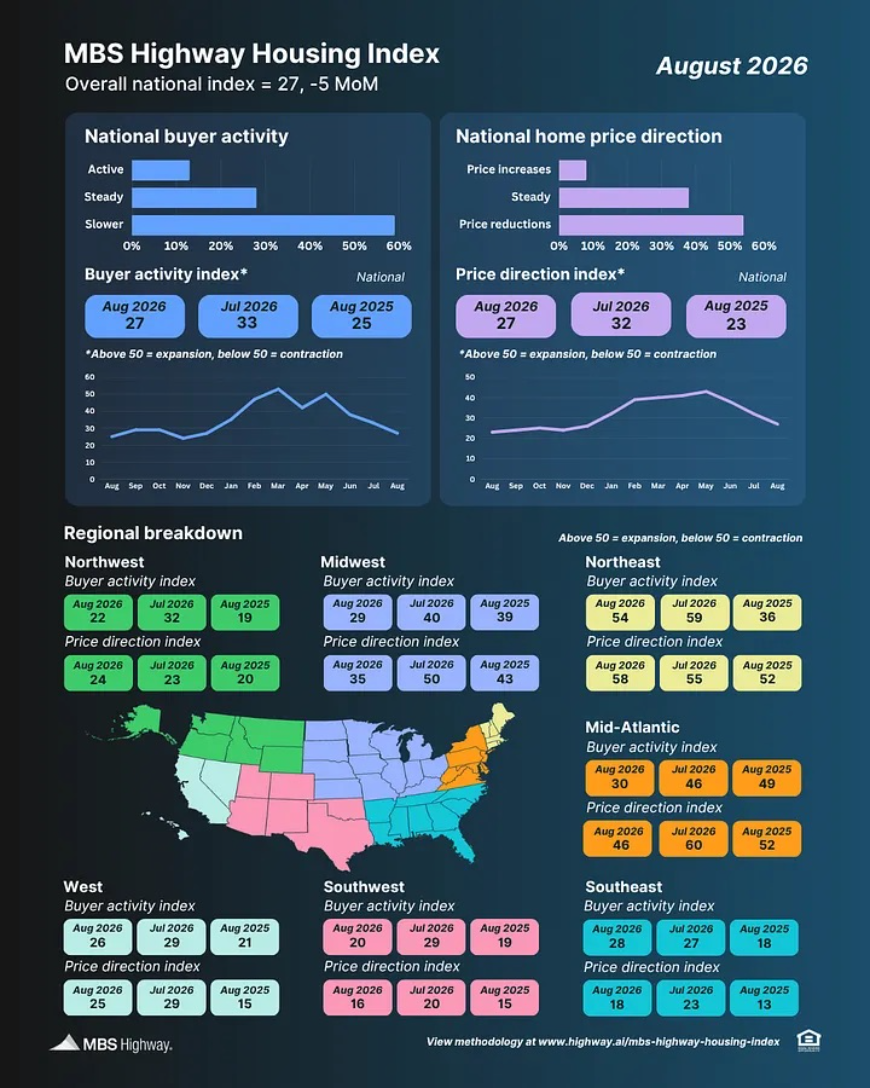
This is a national housing survey of mortgage professionals that seems to indicate slower buyer activity and more sellers willing to negotiate. As always, remember that markets are local. If you have been thinking about buying but have been on the fence, this could mean opportunity, but your timing may play a role.

A lot of potential buyers are sitting on the sidelines today for the same reason.
They're watching rates.
Suppose rates eventually fall into the upper 5% range. The person who has been waiting may decide, This is it. Now I'm ready.
But they probably won't be the only one.
Other buyers may reach exactly the same conclusion.
More buyers can mean more competition for desirable homes, fewer choices, stronger offers and potentially more upward pressure on prices.
In other words, waiting for the perfect boat can have an unintended consequence:
When it finally arrives, everyone else may be trying to get on it too.
The American Dream Has Always Involved Some Uncertainty
Whether it's your first home, your next home as your family grows, a vacation home, or the retirement home you've imagined for years, owning a piece of property remains part of the American Dream for many people.
There has never been a moment when buying a home came without uncertainty. Today, that uncertainty may feel particularly pronounced, with global events such as the war with Iran creating concerns abroad while questions about the economy, employment and the cost of living remain here at home.
Generations before us packed their belongings and headed west without knowing exactly what waited for them. They settled in unfamiliar places, built homes and communities, and took risks because they believed in what they were building.
Our decisions today are obviously very different, but one part hasn't changed:
You can't eliminate every risk before moving forward.
That doesn't mean buying a home simply because you're afraid prices will rise.
It doesn't mean stretching your budget beyond what is comfortable.
And it certainly doesn't mean that everyone should buy right now.
It means looking at the entire picture instead of trying to predict one number.
Is your overall financial situation solid?
Is your income reasonably stable?
Do your jobs appear secure?
Do you have adequate savings and reserves?
Does the payment comfortably fit your budget?
And, most importantly, does the home make sense for the life you're trying to build?
If those pieces are in place, at some point you have to stop trying to perfectly time the water.
Dipping Your Toes In

Understand the numbers.
Understand the risk.
Then decide if it makes sense.